
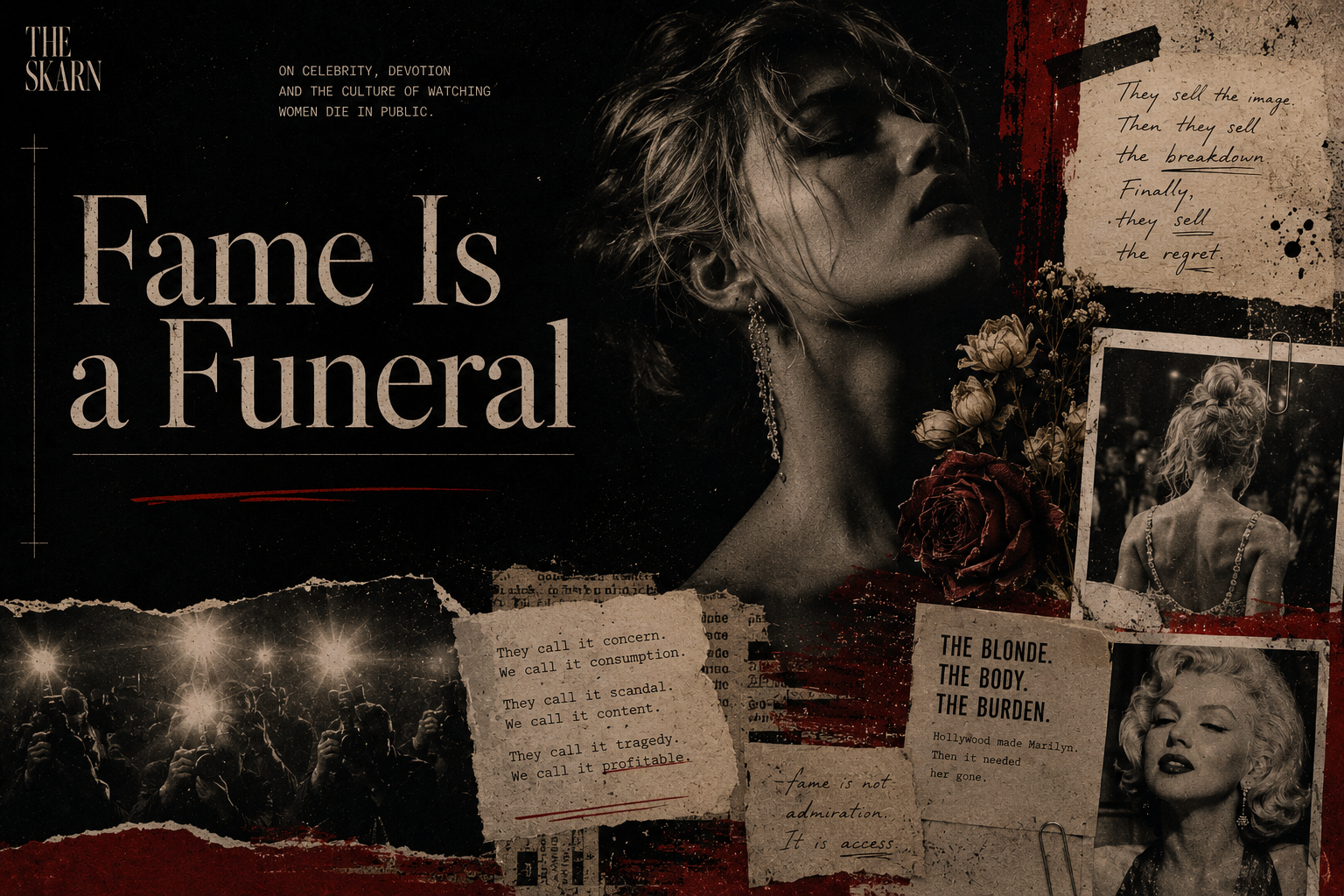
Marilyn Monroe, Britney Spears and the business of mourning women in public
This is not a story about how celebrity culture breaks women.
That story has already been told, and often with the appropriate horror. The interviews have been rewatched. The paparazzi photographs have been reframed. The late-night jokes have curdled into evidence. The public now knows how to say the right words: misogyny, exploitation, media cruelty, institutional control, parasocial violence.
The more difficult question is what happens after that recognition.
What happens when the damage becomes too visible to deny? What happens when a culture that once consumed a woman’s humiliation begins to consume its own remorse? What happens when grief, apology and moral reappraisal become not the end of the machine, but its next commercial phase?
Fame does not only sell beauty, sex, talent or scandal. It also sells aftermath.
It sells the documentary after the breakdown. The prestige essay after the tabloid years. The commemorative collection after the death. The “reconsidered” interview. The trauma timeline. The archival photograph, now presented with better lighting and a more ethical voiceover. The cultural apology, carefully packaged as a new form of consumption.
This is the mourning economy of female celebrity: a system in which public harm is first monetized as spectacle, then monetized again as regret.
Marilyn Monroe and Britney Spears occupy different historical regimes of fame. Monroe was produced by the centralized machinery of the classical Hollywood studio system, where contracts, gossip columns, studio portraits and publicity departments converted a living actress into a controlled image. Spears was produced by the late twentieth-century pop industry and then consumed by a twenty-first-century attention economy of paparazzi photography, cable television, blogs, social media and fan analysis.
Their biographies are not interchangeable. Their industries were not identical. Their legal circumstances were profoundly different.
But their afterlives reveal a shared logic.
Monroe shows what happens when a woman becomes more profitable after death than she was allowed to be in life. Spears shows what happens when a living woman is treated as if she already belongs to the archive of tragedy. One became a productive dead icon. The other became a living obituary.
Together, they expose how celebrity culture does not merely destroy women and move on. It preserves the destruction, aestheticizes it, reinterprets it and sells it back to the public as mourning.
The productive dead woman
Marilyn Monroe’s death in 1962 did not end her commercial life. In many ways, it stabilized it.
A living Monroe was complicated. She was ambitious, ill, late, funny, strategic, sexually coded, professionally frustrated and increasingly resistant to the constraints of the industry that had made her famous. She wanted better roles, more authority and more serious recognition. She formed Marilyn Monroe Productions in the mid-1950s, attempting to create a degree of economic and creative independence from the studio system. She was not simply the passive blonde fantasy that later mythology found useful. She understood image-making because she had helped construct one of the most successful images in modern visual culture.
That was precisely the problem.
A living woman can contradict her own myth. She can ask for money. She can refuse a script. She can arrive late, become ill, challenge a contract, disappoint a director, reject a photographer, contradict an interviewer or insist on being read differently. She can interrupt the uses other people have for her.
A dead woman cannot.
Death made Monroe more available. It removed the difficult facts of personhood and left behind a set of images that could circulate without resistance: the white dress, the red lips, the soft voice, the platinum hair, the face suspended between sexuality and sadness. Her death turned biography into atmosphere. It converted a woman into a symbol flexible enough to serve almost any cultural purpose: glamour, loneliness, Hollywood cruelty, American fantasy, female fragility, erotic innocence, tragic beauty.
The afterlife of Marilyn Monroe demonstrates one of celebrity culture’s most efficient transformations: the conversion of unresolved human damage into endlessly renewable visual property.
Andy Warhol understood this almost immediately. His Marilyn silkscreens did not simply commemorate Monroe; they reproduced the logic of her commodification with ruthless clarity. Her face became repeatable, flattened, detachable from the body that had suffered. The image could multiply precisely because the person was gone.
This is not incidental to Monroe’s legacy. It is central to it.
The dead female icon is one of popular culture’s most durable commercial forms. She is mournable, but not disruptive. Symbolic, but not demanding. Erotic, but not aging. Tragic, but no longer actively suffering. Her pain can be made beautiful because it no longer requires intervention.
In this sense, Monroe’s death was not the collapse of her market value. It was the beginning of a more frictionless form of ownership.
The licensing of her image, the museum exhibitions, the fashion collections, the beauty references, the posters, the books, the documentaries, the pop art, the biopics and the endless visual quotations all participate in the same afterlife economy. They do not always exploit her in the same way, nor do they all carry the same ethical weight. Some reinterpretations are serious, critical and historically attentive. Others are pure aesthetic extraction.
But they all depend on the same condition: Monroe is no longer present to refuse the meanings attached to her.
That absence is profitable.
The living obituary
Britney Spears presents a more unstable case because she survived the tragedy that culture had already begun to narrate.
By the mid-2000s, Spears was no longer treated simply as a pop star. She had become a public crisis text. Her body, marriage, motherhood, sexuality, custody battles, mental health and movements through public space were converted into material for continuous interpretation. The paparazzi image became a form of surveillance evidence. The gossip segment became a diagnostic tool. The tabloid headline became a moral verdict.
Her 2007 and 2008 crisis was consumed as if it were both breaking news and entertainment. Her shaved head, the umbrella incident, her encounters with paparazzi and her hospitalizations were circulated at a velocity that made distress indistinguishable from content. The public did not merely witness her unraveling. It participated in the conditions that made unraveling more likely.
Then came the conservatorship.
Established in 2008 and terminated in 2021, the conservatorship transformed public judgment into legal restriction. Spears continued to work, release music, perform and generate enormous revenue while major decisions about her life, finances and body were controlled by others. Her case exposed a contradiction at the center of celebrity labor under institutional control: she was deemed capable enough to function as a commercial engine, but not autonomous enough to control the life that engine funded.
When Spears addressed the court in June 2021, her statement disrupted years of soft euphemism. She described being forced to work, being medicated against her will and being unable to make basic decisions about her body. Her sentence — “I just want my life back” — became culturally definitive because it reduced the spectacle to its most brutal fact.
She was not asking to be rebranded.
She was asking to be restored to herself.
The termination of the conservatorship in November 2021 appeared, briefly, to offer narrative closure. But celebrity culture does not easily release a woman once it has learned to treat her as public property. Spears’ legal freedom did not produce privacy. It produced a new interpretive market.
Her Instagram posts became objects of forensic attention. Her dancing videos were analyzed as symptoms. Her captions were read as coded messages. Her body remained available for public diagnosis, only now the language had changed. Where the old tabloid culture called her unstable, the new concern culture asked if she was safe. Where the old paparazzi economy followed her through streets, the new parasocial economy followed her through posts.
The structure remained disturbingly familiar.
Spears became a living obituary: a woman discussed through the grammar of tragedy while still alive enough to resist the story.
This is what makes her case so important to the analysis of contemporary fame. The culture did not need Spears to die in order to begin mourning her. It mourned her autonomy, her youth, her “old self,” her lost innocence, her former image, her controlled pop perfection. It treated her survival as a problem of interpretation.
If Monroe’s image became easier to manage after death, Spears’ image became difficult because she continued to speak.
A living woman can ruin a redemption arc.
She can be angry. She can be inconsistent. She can reject gratitude. She can criticize documentaries made in her defense. She can refuse the role of perfect survivor. She can post in ways that make audiences uncomfortable. She can insist on being free without becoming legible.
That illegibility is precisely what celebrity culture struggles to tolerate.
From scandal to reappraisal
The contemporary reappraisal of famous women from the 1990s and 2000s has been necessary. It matters that the culture has revisited the treatment of Britney Spears, Janet Jackson, Paris Hilton, Lindsay Lohan, Amy Winehouse and others. It matters that old interviews are being reassessed, that public shaming is being named, that misogyny once disguised as entertainment is now harder to defend.
But reappraisal is not automatically repair.
It can become another mode of consumption.
The documentary, the podcast series, the prestige magazine essay, the social media thread and the retrospective cultural analysis often depend on the same archive that powered the original harm. The humiliating photograph returns. The cruel interview returns. The footage of distress returns. The woman’s pain is replayed, but now with a changed moral frame.
The audience is invited to look again, and this time to feel ethical while looking.
That is the central tension of the mourning economy. It does not deny that harm occurred. On the contrary, it depends on harm being recognized. Recognition becomes part of the product. The viewer is not positioned as a gossip consumer, but as a witness. The click is not curiosity, but accountability. The rewatch is not voyeurism, but cultural education.
Sometimes this is true.
There are forms of reappraisal that do important corrective work. They restore context, expose institutional failure, challenge old misogynistic narratives and give audiences the tools to understand patterns of abuse that were normalized at the time. Without the public reconsideration of Spears’ conservatorship, the conditions around it may have remained easier to dismiss.
The #FreeBritney movement showed that fan attention can become politically consequential. Fans and activists examined court documents, amplified inconsistencies and sustained pressure around a legal arrangement that had long been treated as either private family business or celebrity eccentricity. In this case, participatory culture helped expose a real institutional crisis.
But the same digital intimacy that made fan activism effective also carries a darker possibility.
Concern can become over-surveillance. Devotion can become entitlement. Protection can begin to resemble possession.
After Spears’ conservatorship ended, certain forms of fan attention did not retreat. They intensified. Some fans continued to analyze her posts for hidden signs of captivity or distress. Others treated her public self-presentation as a puzzle to be solved. The old tabloid assumption — that Britney Spears required constant public interpretation — survived inside a new language of care.
This is not a minor contradiction. It reveals how easily the culture of rescue can reproduce the logic of control.
The question is not whether fans were wrong to care. The question is when care becomes a demand for access.
Respectable exploitation
It is too easy to blame only the obvious villains.
The paparazzi photographer outside the car. The tabloid editor choosing the worst image. The studio executive protecting the investment. The conservator controlling the account. The interviewer asking a young woman about her virginity on national television.
These figures matter. They are part of the machinery. But focusing only on them allows the rest of the culture to imagine itself as innocent.
The mourning economy is sustained not only by the crude tiers of celebrity media, but also by its respectable forms. Prestige documentaries, legacy publications, museum exhibitions, luxury collaborations, literary biographies, academic panels and cultural criticism can all participate in the posthumous or post-crisis consumption of a woman’s image.
This does not make them equivalent. A serious biography is not the same as an invasive paparazzi photograph. A critical documentary is not the same as a cruel tabloid cover. But respectability does not automatically remove extraction. It can refine it.
The respectable layer often performs the same basic conversion as the tabloid layer: a woman’s pain becomes material, her image becomes evidence, and her story becomes a vehicle for someone else’s authority.
In Monroe’s case, the respectable afterlife is especially visible. Her image circulates through museums, auctions, fashion campaigns, art history, branding and academic interpretation. Each new frame claims to recover the “real” Marilyn, but the recovery often depends on reproducing the same face, the same erotic melancholy, the same death-haunted glamour.
In Spears’ case, the respectable layer appears in the post-conservatorship boom of documentaries, investigations, essays and commentary. These works often position themselves against the old media cruelty, yet many of them remain dependent on the archival display of that cruelty. The harm is denounced, but also replayed. The humiliation is criticized, but also used as narrative structure.
This is how apology becomes product.
A culture first generates the conditions for public damage. Then, when the damage becomes morally embarrassing, it generates a secondary market in condemnation. The audience is offered a way to revisit what it once consumed, now with a sense of ethical distance.
The apology does not necessarily interrupt the machine.
It may simply update the packaging.
The archive wants the wound
Both Monroe and Spears reveal the strange hunger of the celebrity archive. It does not preserve only work. It preserves vulnerability.
For male stars, the archive often organizes difficulty as genius, rebellion, excess or complexity. Their destruction may become mythic, but it is frequently folded into narratives of artistic seriousness. For female stars, difficulty is more often organized as evidence of failure: failure to remain desirable, grateful, controlled, maternal, sane, thin, youthful, pleasant or silent.
This difference matters because archives are not neutral containers. They shape what can be remembered and how.
Monroe’s archive is saturated with beauty, but also with absence. The woman is repeatedly searched for beneath the image, yet the search often reproduces the image as its primary evidence. Spears’ archive is saturated with crisis footage, performance clips, interviews, paparazzi images and social media fragments. She is repeatedly interpreted through moments in which she was least protected.
In both cases, the wound becomes the organizing principle.
The culture says it wants to understand these women. But it often returns most obsessively to the moments in which they were exposed, distressed, cornered or dead. The wound promises access. It allows the audience to feel close to someone unknowable. It transforms distance into intimacy, and intimacy into a market.
This is why female celebrity grief is so profitable. It offers the public a way to experience moral emotion without surrendering the pleasures of looking.
We can mourn Monroe and still buy the image.
We can defend Spears and still monitor the post.
We can condemn the old cruelty and still circulate the footage.
The contradiction is not a failure of the system. It is the system.
The final sales cycle
The entertainment machine is often described as cynical, but cynicism may be too simple a word. The machine does not need to hate its subjects. It only needs to convert every stage of their public life into value.
Breakout becomes value.
Sexualization becomes value.
Scandal becomes value.
Crisis becomes value.
Reappraisal becomes value.
Death becomes value.
Remorse becomes value.
This is the full commercial lifecycle of the female star under the mourning economy. The woman is first made visible, then made vulnerable, then made symbolic, then made available for correction, grief or nostalgic repair. If she dies, she becomes a stable icon. If she survives, she becomes an unstable archive that the public continues to manage through interpretation.
The names change. The platforms change. The moral language improves. But the appetite adapts faster than the ethics.
Marilyn Monroe became one of the twentieth century’s most profitable dead women because death made her image permanent and controllable. Britney Spears became one of the twenty-first century’s most overinterpreted living women because survival left her available to a public that had grown accustomed to treating her life as material.
Their cases do not ask the same question.
Monroe asks what a culture does with a woman once she can no longer resist.
Spears asks what a culture does with a woman who survives and refuses to become the version of herself it wants to mourn.
Together, they show that fame is not only a spotlight. It is an extraction system. It extracts beauty, youth, sexuality, labor, vulnerability, scandal, confession, recovery and finally symbolic meaning. When there is nothing left to take from the living body, it takes from the image. When the image becomes morally compromised, it takes from the apology.
That is why fame so often resembles a funeral.
Not because every famous woman dies.
Because the culture begins rehearsing the mourning while she is still alive.
Against the beautiful apology
The ethical problem is not that we remember famous women who were harmed. Forgetting would be another violence. The problem is how easily remembrance becomes possession.
To remember Marilyn Monroe responsibly is not simply to reproduce her face forever under the sign of tragedy. It is to keep returning to the systems that profited from her while refusing to reduce her to the beautiful evidence of those systems. To care about Britney Spears is not to monitor her endlessly in the name of concern. It is to accept that freedom includes the right to become illegible to the audience.
The public does not need to stop analyzing celebrity culture. But it does need to become more suspicious of its own pleasure in analysis.
Why do we return to the breakdown?
Why do we need the footage again?
Why does the apology require so much evidence of the original harm?
Why does a woman’s pain become more culturally valuable once it can be framed as a lesson?
These questions do not have clean answers because the audience is not outside the machinery. We are part of its distribution system. We click, stream, buy, quote, share, condemn, archive and rewatch. We may do so with serious intentions, but intention does not erase participation.
The mourning economy survives because it offers a morally improved version of the same old access.
It lets us keep looking.
It lets us call the looking care.
It lets us purchase the apology and mistake that purchase for change.
Marilyn Monroe became easier to love once she could no longer interrupt the myth. Britney Spears became harder to contain because she remained alive enough to reject the meanings imposed on her. Between them lies one of celebrity culture’s most persistent truths: the public often recognizes a woman’s humanity only after it has become profitable to mourn what was done to her.
The funeral is not the end of the story.
It is the business model.