
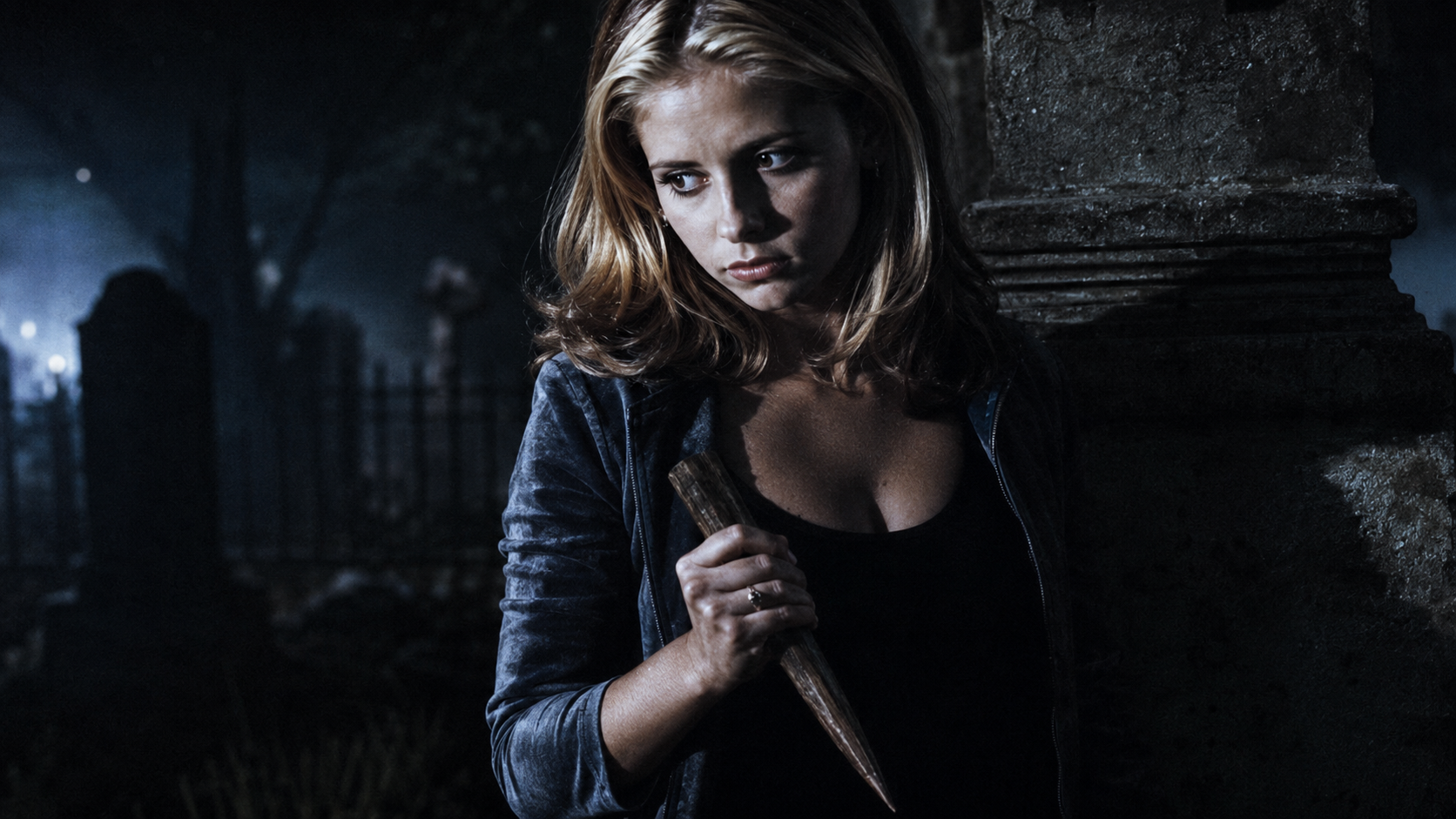
Before she was an icon, Buffy was a girl with homework, lip gloss and a grave waiting for her.
There are heroines who arrive already carved in marble. Buffy Summers was never one of them. She arrived chewing gum, wearing mini skirts, failing classes, getting grounded, wanting dates, wanting friends, wanting one normal night without blood on her clothes.
She was not introduced as a fantasy of masculine power in a smaller body but as a contradiction: a teenage girl asked to carry an ancient masculine story on her back.
The chosen one. The warrior. The sacrifice.
But Buffy the Vampire Slayer understood something many later genre stories forgot: being chosen is not empowerment by itself. Sometimes it is a sentence.
Buffy’s power is real. Her suffering is real too. The show’s genius lies in refusing to separate them.
The blonde who was supposed to die first
Buffy began as a reversal of an image.
In horror, the pretty blonde girl often exists to be chased, punished, exposed or killed. She is the body the camera follows before the monster reaches her. She runs upstairs when she should run out the door. She screams. She disappears. Her beauty becomes evidence against her.
Buffy took that figure and gave her a weapon.
But the reversal was never simple. The show did not merely say: what if the victim fought back? It asked what happens after she fights back every night. What happens when survival becomes routine. What happens when the final girl is not allowed to be final, because the apocalypse keeps returning.
Buffy is not powerful because she escapes the horror film. She is powerful because she has to live inside it.
Again. And again. And again.
Her body becomes the site where American teen fantasy and gothic violence collide. Cheerleader, daughter, student, friend, lover, killer. She moves through cemeteries in clothes that belong to daylight. That contrast is not accidental. Buffy always looks like she has been dragged from one genre into another.
She is the girl from the mall standing at the mouth of hell.

The burden dressed as destiny
The language of the Slayer mythology sounds grand until you listen closely.
“One girl in all the world.”
It sounds special. It is also brutally isolating.
Buffy is told that her calling makes her exceptional, but the structure around that calling treats her as disposable. Slayers die young. Another one is activated. The machine continues. The girl is replaceable, even when the myth insists she is unique.
This is where Buffy becomes more than a clever horror premise. It becomes a story about institutions that romanticize the suffering of young women while depending on it.
The Watchers’ Council does not create Buffy’s strength. It manages it, disciplines it, interprets it, withholds information from it and tries to control the terms under which it can exist. Buffy’s power predates their authority, but they still behave as if they own the narrative.
That tension runs through the entire series. Buffy has strength, but everyone wants meaning from it. Men want prophecy. Institutions want obedience. Evil wants spectacle. Friends want saving. Lovers want access. The world wants her body between itself and destruction.
She is not just fighting monsters. She is fighting the story that was written around her before she had the chance to write herself.
Sunnydale as a wound with suburbs on top
Sunnydale is one of television’s great lies.
It has schools, sidewalks, bedrooms, Bronze nights, family dinners, cheerleading tryouts and municipal denial. It looks like a place where adolescence can happen in the usual way. Underneath it is the Hellmouth.
That is not just a setting. It is the whole thesis.
The show understands adolescence as a kind of haunting. Every ordinary teenage experience opens into horror. A bad boyfriend becomes a monster. A secret becomes a curse. A school hallway becomes a hunting ground. Desire has teeth. Shame has a body. Grief rises from the grave.
The metaphor could turn blunt. Often it does not. At its best, Buffy treats supernatural horror as the visible form of emotional violence. The monsters are not decorations. They are what the feeling looks like when it stops pretending to be manageable.
This is why the show’s imagery still sticks: cemeteries at night, crosses against skin, library stacks, blood on prom dresses, the Bronze as a half-lit ritual space, a suburban house that never feels entirely safe. Buffy’s world has a strangely tactile darkness. Wood, dust, leather, candlelight, stone, blood.
It is gothic without the distance. The horror is local. It has a locker combination.
The tragedy of having to keep going
Buffy dies more than once, but the show’s darkest insight is not death. It is continuation.
She is killed, revived, expelled, abandoned, betrayed, resurrected. She is broke, exhausted and still expected to function. There are episodes where the central horror is not a demon but the simple fact that life keeps asking things of her.
This is where Buffy becomes painfully adult.
The early fantasy is that power solves vulnerability. The later seasons dismantle that fantasy. Buffy can defeat ancient evil and still be unable to pay bills. She can save the world and still feel alienated from it. She can return from heaven and be expected to say thank you.
The show often frames heroism as interruption: every time Buffy reaches toward ordinary happiness, the myth reclaims her. A date becomes a patrol. A party becomes an attack. A domestic moment becomes a crisis. Even rest becomes temporary.
She is not denied softness because she lacks it. She is denied softness because the world has learned to survive by extracting her strength.
That is the violence of being chosen. Not only the fight itself, but the expectation that you will continue to fight while remaining recognizable, desirable, grateful and good.
Buffy, beauty and the weaponized girl
The visual power of Buffy lies in its refusal to make strength look separate from femininity.
Buffy does not become powerful by rejecting beauty, fashion or girlhood. She fights in boots, dresses, tank tops, leather jackets, prom clothes and impractical coats. Her femininity is not a disguise over the warrior. It is part of the image.

That mattered.
The show did not invent the strong female character, but it gave mainstream television one of its most enduring versions: a girl whose beauty did not cancel her violence, whose vulnerability did not cancel her authority, whose desire for normal life did not make her weak.
Still, the image is complicated. Buffy is also an object of the gaze. She is styled, watched, desired and mythologized. The show critiques the consumption of young women while also participating in it. That contradiction does not ruin Buffy. It makes her more revealing.
She exists at the unstable intersection of empowerment and spectacle. She is allowed to hit back, but she is still made beautiful while doing it. She breaks the horror formula, but she remains inside the visual economy that formula helped create.
The Skarn rule applies: the image is never innocent.
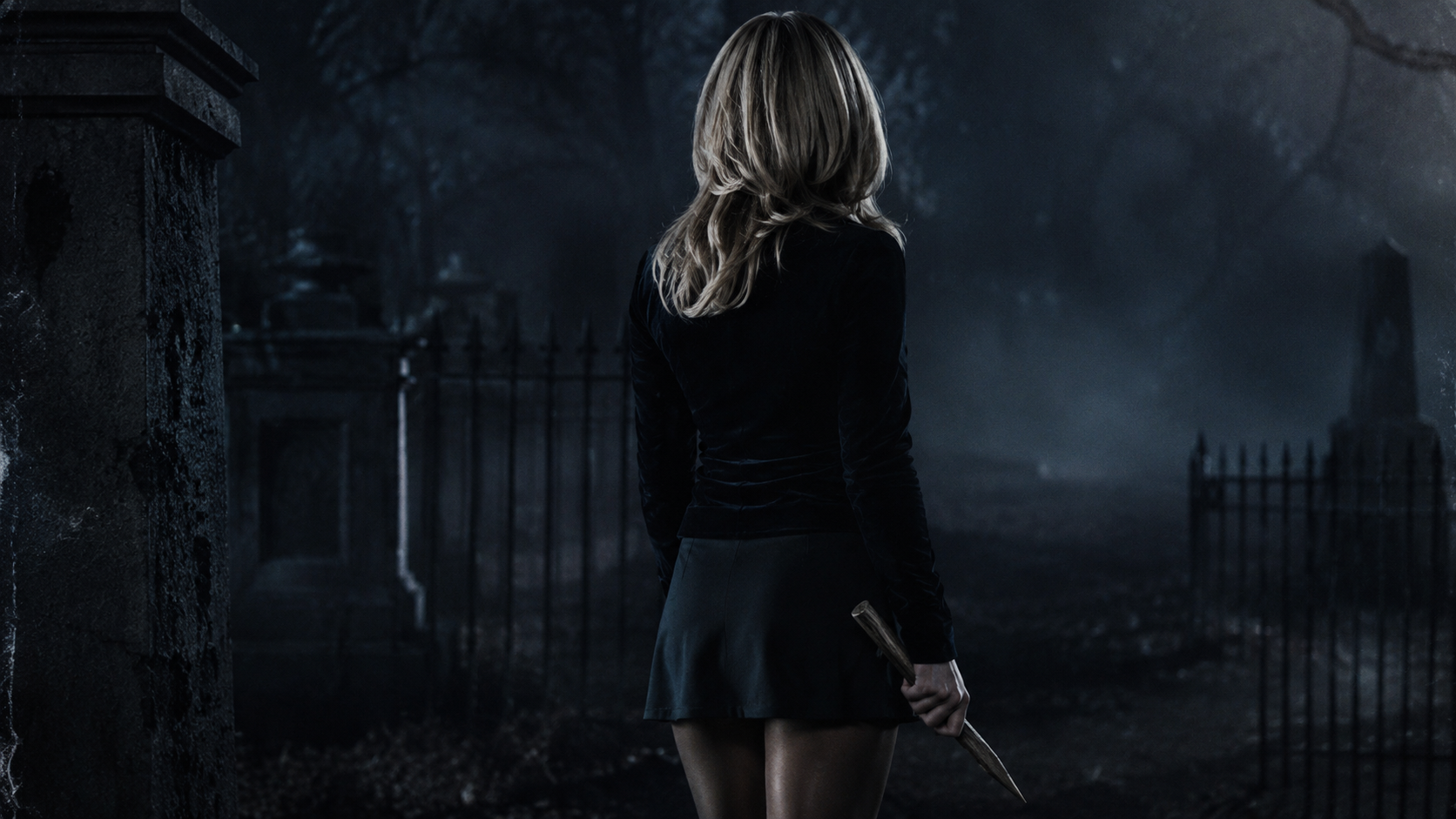
The girl who changed the prophecy
The most radical thing Buffy does is not killing vampires. It is refusing singularity.
The Slayer myth depends on isolation: one girl, one burden, one body against the dark, and a system that works by making each of them believe she stands alone.
Buffy’s final act breaks that structure.
She does not simply win within the old mythology. She redistributes it. She turns exception into collective power. The chosen one becomes the chosen many.
That ending matters because it reframes the entire series. Buffy’s loneliness was never sacred. It was engineered. Her isolation was not the price of power. It was the method of control.
By the end, Buffy does not abandon the myth. She ruins it from the inside.
What survives
Buffy the Vampire Slayer survives because it understood that monsters were never the only monsters.
The show gave us vampires, demons, witches, gods and apocalypses, but its real subject was the cost of being made symbolic too young. Buffy is a girl turned into a weapon, a body conscripted as a border, a person flattened into a prophecy.
She is funny, vain, brave, cruel, loving, tired, stubborn and often impossible. That is why she still works. She was never just a slogan in platform boots. She was a character carrying the unbearable contradiction of being both ordinary and mythic.
The culture remembers Buffy as empowerment, and that is not wrong. But it is incomplete.
Buffy is not only about a girl who could fight monsters.
It is about a girl who kept being asked to save a world that rarely asked what saving it cost her.