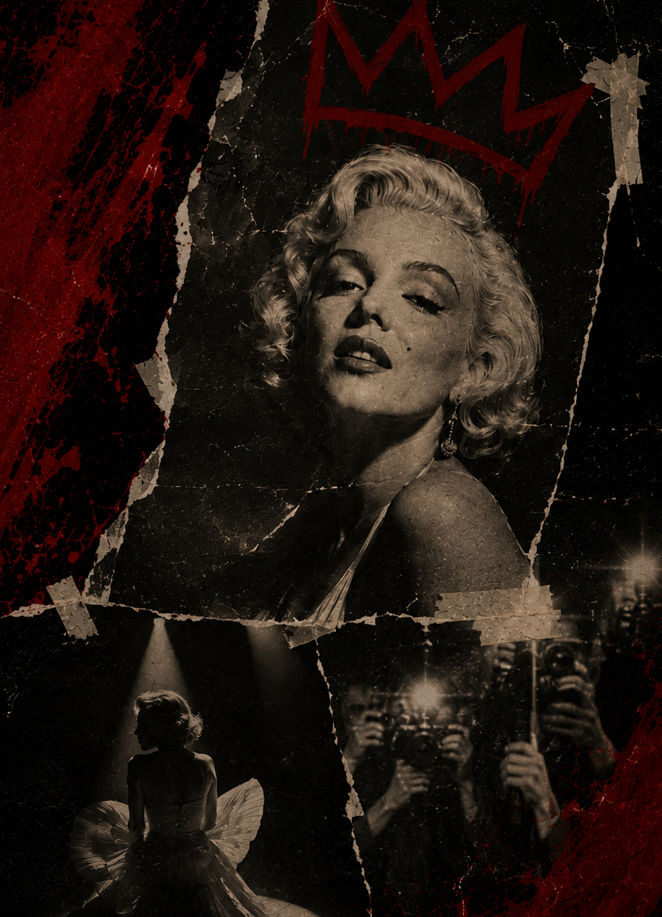
One hundred years after her birth, Marilyn Monroe remains one of culture’s most reproduced images — but behind the myth was an artist who understood fame, fought its limits and was ultimately trapped by its beauty.
On June 1, 2026, Marilyn Monroe would have turned 100. It is a strange sentence to write, because Monroe has never been allowed to age. In the public imagination, she remains suspended somewhere between the white dress, the red lips, the breathy voice and the tragic ending. She is forever blonde, forever luminous, forever 36.
That is part of the problem.
Marilyn Monroe has become one of the most reproduced faces in modern culture. Her image has been printed on posters, T-shirts, perfume bottles, art books, coffee mugs and gallery walls. She has been turned into glamour, tragedy, warning, fantasy and brand. But the more familiar the image becomes, the easier it is to forget the woman who made it.
Born Norma Jeane Mortenson in Los Angeles in 1926, Monroe’s early life was marked by instability, foster homes and a hunger for transformation. Hollywood gave her a name, a look and a mythology, but it did not invent her intelligence. Monroe understood the camera. She understood performance. She understood that femininity could be both costume and currency.
The tragedy is not that she was naïve about fame. It is that she saw the machinery clearly and still could not escape it.
By the 1950s, Monroe had become one of the defining stars of American cinema. Films such as Gentlemen Prefer Blondes, How to Marry a Millionaire, The Seven Year Itch and Some Like It Hot fixed her in the public imagination as the ultimate blonde bombshell. But the phrase has always been too small for her. It reduces craft to body, timing to charm, intelligence to instinct.
Monroe was funny. That should not be treated as a footnote. Her comic performances required precision, rhythm and self-awareness. She knew how to make desire look effortless and absurd at the same time. She could play the fantasy while quietly exposing how ridiculous the fantasy was.
She also wanted more.
In the mid-1950s, she challenged the limitations of her studio contract and formed Marilyn Monroe Productions, an unusually bold move for a female star of her time. She wanted better roles, more control and the right to be taken seriously. Hollywood loved her most when she was available as an image. It became less comfortable when she wanted authority over that image.
This tension followed her to the end. As her health, work and private life became increasingly unstable, the press turned her into a simpler story: beautiful, difficult, fragile, doomed. After her death in 1962, that story hardened into myth.

Death made Monroe easier for the culture to love. It removed the ambition, the anger, the negotiations, the illnesses, the contradictions and the unfinished work. What remained was the face.
At 100, Marilyn Monroe should not only be remembered as a symbol of glamour or sadness. She should be remembered as an artist who fought the limits of the role she had been given. A woman who understood the image, shaped it, suffered under it and was ultimately trapped by how profitable it became.
The most honest tribute is not to keep repeating the myth. It is to look beneath it.
Marilyn Monroe was never only the beautiful face and the sad ending. She was the person the myth was built over.